
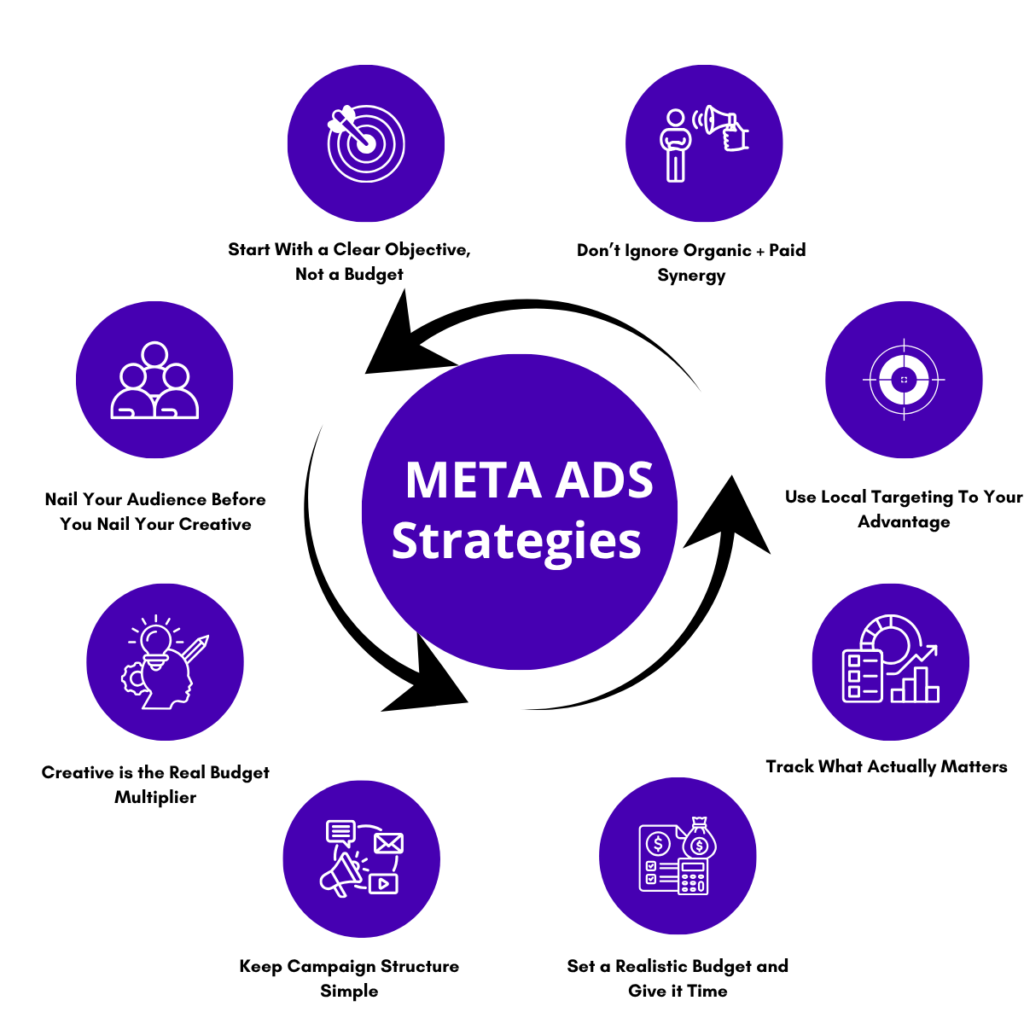
If you run a small business, you’ve probably heard that Meta Ads “can change everything” — and then watched your ad spend disappear with little to show for it. The truth is, Meta Ads strategies for small business growth genuinely work — but only when you replace guesswork with a system.
1. Start With a Clear Campaign Objective, Not a Budget
Before you open Meta Ads Manager, decide what “success” actually looks like for your business. Are you trying to:
- Drive website traffic or online sales
- Generate leads (form fills, calls, WhatsApp messages)
- Build local foot traffic to a physical store
- Grow brand awareness for a new product
Meta’s algorithm optimizes for whatever objective you select. Choosing “Engagement” when you actually want sales gets you likes and comments — not paying customers. Matching your campaign objective to your real business goal is the single most overlooked Meta Ads strategy for small business owners.
2. Nail Your Audience Before You Nail Your Creative
Small businesses often waste ad spend by targeting audiences that are too broad or too narrow. A few reliable Facebook and Instagram ads targeting approaches:
- Start broad and let Meta optimize. The algorithm is surprisingly effective at finding buyers when given a wide net and a clear conversion signal (via Meta Pixel or Conversions API).
- Retarget warm audiences first. Website visitors, page engagers, and cart abandoners convert far more cheaply than cold traffic. Always run a retargeting campaign alongside prospecting.
- Build lookalike audiences from your existing customer list once you have 100–500+ data points — one of the highest-ROI small business Facebook ads strategies available.
3. Creative Is the Real Budget Multiplier
Perfect targeting still fails if your ad creative doesn’t stop the scroll. For small business Meta Ads specifically:
- Use real product or service footage, not stock photos — authenticity consistently outperforms polish in the feed.
- Lead with the problem, not the product. “Tired of invoices taking 3 days to get paid?” beats “Introducing our new invoicing software.”
- Prioritize short-form video. Native-feeling 15–30 second videos consistently outperform static images for small business ad budgets.
- Show real customer testimonials. Social proof lowers cost-per-result without increasing spend.
Test at least 3–5 creative variations per campaign and let performance data — not personal preference — pick the winner.
4. Keep Campaign Structure Simple
Small budgets get diluted fast when spread across too many ad sets. A lean Meta Ads account structure that works well for small businesses:
- One campaign per objective
- 2–3 ad sets maximum (e.g., broad, retargeting, lookalike)
- 3–5 ads per ad set
This gives the algorithm enough data per ad set to exit the learning phase quickly — a key reason many small business Facebook ad campaigns underperform: budgets spread too thin to ever optimize.
5. Set a Realistic Budget and Give It Time
A common mistake: launching with $10/day and expecting profitability within 48 hours. Meta’s algorithm typically needs around 50 conversion events per ad set per week to exit the learning phase and optimize efficiently.
If your budget can’t realistically hit that volume:
- Optimize for a cheaper, earlier funnel event (e.g., “Add to Cart” instead of “Purchase”) until you gather enough data
- Consolidate spend into fewer ad sets
- Let campaigns run 7–14 days minimum before judging results
6. Track What Actually Matters for Meta Ads strategies
Vanity metrics like reach and impressions feel good but don’t grow revenue. For small business Meta Ads ROI, focus on:
- Cost per result (cost per lead, cost per purchase)
- Return on ad spend (ROAS)
- Customer acquisition cost (CAC) vs. lifetime value (LTV)
Set up your Meta Pixel and Conversions API correctly — without accurate tracking, both you and Meta’s algorithm are optimizing blind.
7. Use Local Targeting to Your Advantage
Local businesses — cafés, salons, clinics, boutiques — have an edge national brands don’t: hyper-local relevance. To make the most of local Meta Ads targeting:
- Target a tight 2–10 km radius around your location
- Use location-specific ad copy (“Now open in [neighborhood]”)
- Run “Store Traffic” or “Local Awareness” objectives where available
- Promote limited-time local offers to create urgency
8. Don’t Ignore Organic + Paid Synergy
Ads amplify what’s already working — they rarely fix a weak brand presence from scratch. Before scaling spend:
- Make sure your Instagram/Facebook profile builds trust (bio, reviews, recent activity)
- Repurpose top-performing organic posts as ads — they often convert better than ads made from scratch
- Reply to comments and DMs quickly, since ad-driven traffic frequently checks your profile before buying
Frequently Asked Questions for Meta Ads strategies
What is the best Meta Ads strategy for a small business with a limited budget? Start with a single, clear objective, a simple campaign structure (1 campaign, 2–3 ad sets), and prioritize retargeting warm traffic before scaling to cold audiences — it’s the fastest way to see ROI on a small budget.
How much should a small business spend on Meta Ads per month? There’s no universal number, but a good starting range is enough to generate at least 50 conversion events per ad set per week. For most small businesses, that’s roughly $300–$1,000/month, adjusted for industry and average order value.
How long does it take to see results from Facebook and Instagram ads? Give campaigns at least 7–14 days to exit Meta’s learning phase before evaluating performance. Judging results too early is one of the most common small business advertising mistakes.
Meta ads strategies better for small businesses? Both run through the same Meta Ads Manager and can be combined in one campaign. Instagram tends to perform better for visually-driven products, while Facebook often works well for local services and older demographics — testing both is recommended.
Final Thoughts for Meta Ads strategies
Meta Ads strategies aren’t a magic switch — they’re a tool that rewards clear goals, disciplined structure, and consistent testing. For small businesses, the winning formula is:
Simple campaign structure + strong creative + proper tracking + patience through the learning phase.
Start small, test deliberately, double down on what works, and resist the urge to overhaul campaigns before they’ve had a real chance to optimize. That’s how small businesses turn Meta Ads into their most reliable growth channel.